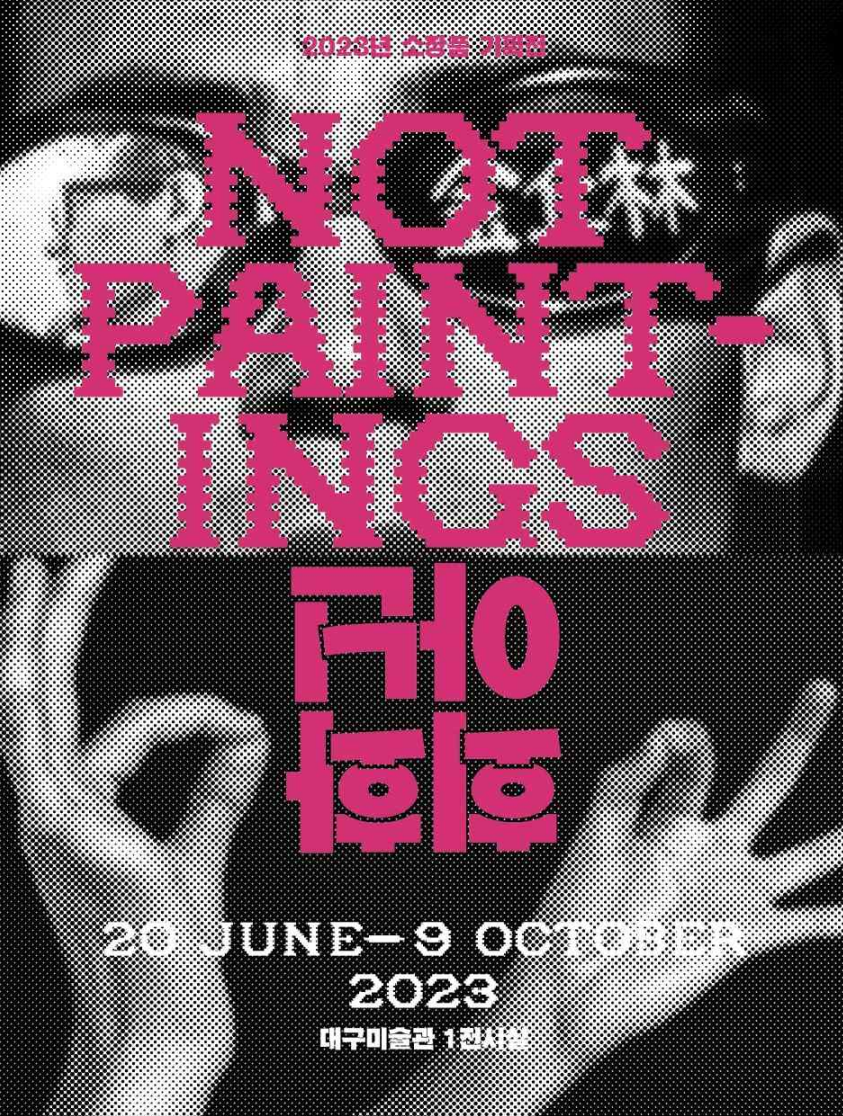
On display through October 9, 2023, Not Paintings, Daegu Art Museum’s special exhibition, introduces 34 works of media and photography from the museum’s collection, which it has been collecting since before its opening. The exhibition explores how art forms have been transformed and expanded through encounters between art and technological media.
For a few years, the Daegu Museum of Art has been studying its collections to identify trends in contemporary art and presenting them through exhibitions.
Modern Life, held in 2021, was a project co-organized with the Fondation Marguerite et Aimé Maeght in France. It was a collaborative study of the collections of both institutions under the theme of modernism. Held in 2022, A Season of Meditation was an exhibition that explored people and humanity through 93 works from the Daegu Art Museum’s collection, including paintings, photographs, sculptures, and new media.
The exhibition Not Paintings, which opened on June 20 and runs through October 9, introduces 34 works of media and photography from the museum’s collection, which it has been collecting since before its opening in May 2011. The exhibition explores how art forms have been transformed and expanded through encounters between art and technological media.
These mediums, driven by technological advancements, are now being widely utilized as both a method and tool in the realm of artistic creations. “This exhibition aims not to merely showcase contemporary artworks that reflect the trends of the latest technology but to explore the changes and attributes that emerged from the intersection of art and technology,” said Park Bo-ram, the curator who organized the exhibition.
As art intersects with technological mediums, the paradigm of the act of “seeing” has undergone a profound transformation, along with the essential concept of art itself. Art has expanded from canvases to digital screens and from still images to moving videos.
A significant element that has emerged in these new art forms is “time.” Photography made us able to capture singular moments within a short period of time. Video-imaging technology enabled us to capture time in motion. And digital-based technology has allowed us to express non-linear timelines, enabling time to flow in reverse or be fragmented.
Furthermore, technology-based art has transcended the material properties of traditional mediums. Conventional paintings require paints and canvases, while sculptures require materials such as clay, plaster, or metal. However, with the advancement of digital technology, contemporary artists now have the freedom to choose from various modes of expression. Today, artists can explore a wide range of mediums, including photography, videography, graphic editing, scanning, compositing, 3D animation, virtual reality (VR), and multi-channel videos. This expansion of mediums has not only brought about changes in techniques and modes of expression but also in distribution methods.
Through the museum’s collection, the exhibition aims to show these changes in art.
This exhibition features works by artists from Daegu, such as Lee Kang-So, Park Hyunki, and Kim Kulim, who used video to conduct new media experiments, as well as works by the first generation of Korean media artists, including Nam June Paik, Kim Soun-Gui, and Kim Haemin, alongside works by contemporary artists who are currently actively engaged in their artistic practices.
Daegu was a center of the textile industry at the forefront of Korea’s industrialization and urbanization during the 1970s and ’80s. As capital flowed into Daegu, several galleries emerged, fostering the development of a unique and independent contemporary art scene distinct from Seoul. The Daegu Contemporary Art Festival played a significant role in this development.
Founded in 1974, the festival served as a focal point for artists nationwide, preceding its Seoul counterpart. In particular, during the fifth Daegu Contemporary Art Festival in 1979, artists like Lee Kang-So, Park Hyunki, Kim Youngjin, and Lee Hyunjae presented video works that contributed to the establishment of video art as a genre within the art world.
The exhibition is divided into three main themes.
The first section introduces a group of artists who expanded the boundaries of art, including Kim Kulim, Kim Soun-Gui, Kim Haemin, Park Hyunki, Nam June Paik, Lee Kang-So, and Chung Jae-kyoo. This section examines video installations and TV sculptures that emerged at a time when video art was first introduced and embraced in Korea, as well as formal explorations of frames, photography as a conceptual perception, and a general interest in mass media.
The second section features work by artists such as Kim Kulim, Kim Shinil, Oh Min, Moojin, Oh Junghyang, Lim Changmin, and Jeong Jeongju. This section explores the element of “time” that has emerged with the advent of new media art. Through the digital revolution and resulting medium experimentation, artworks now have the capability to express a new sense of “temporality.” This allows for the incorporation of new elements such as sound, interactivity, and multi-channel variations within the artwork. Here, the exhibition showcases works that capture moments of simultaneity and depict non-linear temporalities.
The last section explores the blurring of the boundaries between the virtual and the real in art through works by artists such as Yoo Hyunmi, Lim Taek, Lim Changmin, Wang Qingsong, Jeong Yeondoo, Ryu Hyunmin, Jade Sujin Lee, Debbie Han, Jo Seub, and Jun Sojung. Particularly when exploring such boundaries, digital photography and video allow for editing and compositing, making them popular tools of expression for many artists. Through works that traverse between the virtual and the real, artists freely express playfulness, reflections on reality, and questions and predictions about the future.
최근 몇 년간 대구미술관은 수집한 소장품을 연구하여 동시대 미술의 경향을 파악하고 이를 선보이는 전시를 마련해 왔다.
2021년에 개최된 “모던 라이프”전은 ‘모더니즘’을 주제어로 삼아 프랑스 매그 재단(Fondation Marguerite et Aimé Maeght)과 공동 주최해 양 기관의 소장품을 공동 연구한 프로젝트였다. 2022년에 개최된 “나를 만나는 계절”전은 회화, 사진, 조각, 뉴미디어 등 대구미술관 소장품 93점을 통해 인간에 대해 고찰한 전시였다.
지난 6월 20일에 개막해 10월 9일까지 진행되는 대구미술관 소장품 기획전 “회화 아닌(Not Paintings)”은 미술관이 개관하기 이전부터 수집해 온 미술관 소장품 중 미디어와 사진 작품 34점을 소개한다. 이번 전시는 특히 미술과 기술 매체의 만남을 통해 미술 형식이 어떻게 새롭게 변화하고 확장되었는지 살펴본다.
기술 발전에 힘입어 새롭게 등장한 매체들은 이제 예술 작품에 있어서 하나의 도구이자 표현 방식으로 널리 활용되고 있다.
전시를 기획한 박보람 학예연구사는 “이번 전시는 단순히 최신 기술의 흐름을 반영하는 동시대 작품을 선보이기보다는 미술과 기술의 만남으로 인해 나타난 변화와 그 속성을 탐구하는 데 목적을 두고 있다”고 말했다.
미술이 기술 매체와 만나면서 미술의 본질적 개념과 본다는 행위의 패러다임은 근본적인 변화를 겪었다. 미술은 캔버스에서 디지털 화면으로, 정지된 이미지에서 움직이는 영상으로 확장되었다.
이러한 새로운 미술 형식에서 중요한 요소로 등장한 것이 ‘시간’이다. 사진 기술을 통해 우리는 짧은 시간 내에 순간을 포착할 수 있게 되었고, 비디오 기술은 흐르는 시간을 영상으로 담아낼 수 있도록 했으며, 디지털 기반의 컴퓨터 기술은 한쪽으로 흐르는 대신 과거로 되돌아가거나 분절되는 등 비선형적으로 흐르는 타임라인을 가능하게 해 주었다.
또한 기술 기반 예술은 전통적 매체의 물성적 특징을 탈피하였다. 우리가 흔히 알고 있는 회화는 물감과 캔버스로 이루어졌으며, 조각은 찰흙, 석고, 철과 같은 재료를 필요로 한다. 하지만 디지털 기술의 발전으로 현대 예술가들은 이제 다양한 표현 방식을 자유롭게 선택할 수 있게 되었다. 사진, 비디오, 그래픽 편집, 스캔, 합성, 3D 애니메이션, 가상 현실(VR), 다채널 영상으로 매체가 확장된 현재에는 기법, 표현 방식, 나아가 유통 방식에도 변화가 생겼다.
전시는 이러한 미술의 변화를 미술관 소장품을 통해 보여 주고자 한다.
이번 전시에서는 1970년대 대구를 중심으로 비디오라는 새로운 매체를 실험했던 이강소, 박현기, 김구림 등의 작품을 살펴볼 수 있으며 나아가 백남준, 김순기, 김해민 등 국내 미디어 1세대 작가들과 더불어 현재 활발하게 활동 중인 동시대 작가들의 작품들을 함께 선보인다.
대구미술관이 위치한 대구는 1970년대에서 1980년대 우리나라의 산업화와 도시화를 이끈 섬유 산업 중심지였다. 대구에 자본이 유입되면서 여러 갤러리가 생겨났고, 서울과는 다른 독자적인 미술을 발전시켰다.
특히 1979년 제5회 대구현대미술제에서는 이강소, 박현기, 김영진, 이현재 등의 작가가 비디오 작품을 선보이며 비디오 아트가 한국 미술계에서 하나의 장르로 자리매김하는 데 기여했다.
전시는 크게 ‘확장하는 눈’, ‘펼쳐진 시간’, ‘경계 없는 세계’ 등의 세 주제로 나뉘어 관련 소장품들을 조명한다.
첫 번째 주제 ‘확장하는 눈’에서는 김구림, 김순기, 김해민, 박현기, 백남준, 이강소, 정재규 등 미술의 외연을 확장했던 일군의 작가들을 소개한다. 이 섹션에서는 비디오 아트가 한국에 처음 소개 및 수용되었던 시기에 등장한 비디오 설치와 TV 조각을 선보이는 것과 더불어 프레임에 대한 형식적 탐구, 개념적 인식으로의 사진, 대중 매체에 대한 관심 등 여러 관점을 살핀다.
두 번째 주제인 ‘펼쳐진 시간’에서는 김구림, 김신일, 오민, 무진형제, 오정향, 임창민, 정정주의 작품을 만나볼 수 있다. 이 섹션 뉴미디어 예술이 등장하면서 떠오르게 된 ‘시간’적 요소를 다룬다. 작가들은 디지털 혁명을 통해서 매체적 실험과 함께 미술 작품 속에서 새로운 ‘시간성’을 표현하는 것이 가능해지면서 작품에 음향, 인터랙티브, 채널의 다변화 등 새로운 요소들을 개입시킬 수 있게 되었다. 두 번째 섹션에는 순간의 동시성을 포착하고 비선형적 시간을 표현한 작품들을 선보인다.
마지막으로 ‘경계 없는 세계’에서는 유현미, 임택, 임창민, 왕칭송, 정연두, 류현민, 이수진, 데비 한, 조습, 전소정의 작품을 통해 가상과 실재의 경계가 불명확해진 예술 세계를 조명한다. 디지털 사진과 영상은 편집과 합성이 가능해 많은 작가가 표현의 도구로 사용하고 있다. 가상과 실제를 오가는 작품을 통해 작가들은 유희, 현실에 대한 성찰 그리고 다가올 미래에 대한 물음과 예언을 자유롭게 나타낸다.
https://k-artist.com/ko/Artist_Posts.php?tab_num=tab5&co_id=1726511905

No comments:
Post a Comment