Haus for Media Art Oldenburg Katharinenstraße 23 Oldenburg D-26121, Germany
Participating artists: Orla Barry, Kim Beom, Kasper Bosmans, Jeamin Cha, Mitsutoshi Hanaga, Tamás Kaszás, Krisztián Kristóf and The Randomroutines, Eustachy Kossakowski, Sharon Lockhart, Deirdre O’Mahony, Peter Nadin & Natsuko Uchino & Aimée Toledano, Rory Pilgrim, Iza Tarasewicz and Jennifer Walshe.
The Oldenburg Gleaners Society Club is an exhibition and assembly of people and things, departing from the idea and practice of “gleaning.” The term traditionally refers to collecting surplus crops following a harvest and redistributing them to people in need. This act—common from biblical times up until the 1700s—was a strategy of survival and resourcefulness, essential to those marginalized by the emerging forces of capitalism: widows and orphans, the poor and expropriated, newcomers and exiles. The Oldenburg Gleaners Society Club, curated by Sebastian Cichocki, is a spinoff of his The Gleaners Society, presented at the 40th EVA International—Ireland’s Biennial of Contemporary Art. The exhibitions position gleaning alternately as an artistic subject, a metaphor, and a curatorial methodology. Most of the works in the Oldenburg exhibition were “gleaned” locally, using found materials and objects, while others were transferred as digital files. The exhibition, rather than involving traditional physical shipping, prioritizes protocol-based works related to agricultural processes.
The Oldenburg Gleaners Society Club is an exhibition and assembly of people and things, departing from the idea and practice of “gleaning.” The term traditionally refers to collecting surplus crops following a harvest and redistributing them to people in need. This act—common from biblical times up until the 1700s—was a strategy of survival and resourcefulness, essential to those marginalized by the emerging forces of capitalism: widows and orphans, the poor and expropriated, newcomers and exiles. The Oldenburg Gleaners Society Club, curated by Sebastian Cichocki, is a spinoff of his The Gleaners Society, presented at the 40th EVA International—Ireland’s Biennial of Contemporary Art. The exhibitions position gleaning alternately as an artistic subject, a metaphor, and a curatorial methodology. Most of the works in the Oldenburg exhibition were “gleaned” locally, using found materials and objects, while others were transferred as digital files. The exhibition, rather than involving traditional physical shipping, prioritizes protocol-based works related to agricultural processes.
Artistic practices informed by degrowth philosophies—focused on sustainability and adaptation, and which do not always produce tangible works of art—often take root in other fields, such as political activism, radical pedagogy, and experimental farming. Inspired by the work of Irish visual artist and shepherd Orla Barry, the exhibition in Oldenburg moves fluidly between the farm and the gallery, searching for “post-pastoral” artistic practices. Barry exhibits a mountain of sheep’s wool that went unsold because the purchase price was too low, echoing the language of arte povera. Natsuko Uchino uses objects and materials found in Oldenburg, drawing on agricultural and craft histories and the circulation of knowledge and goods. Deirdre O’Mahony presents a musical video work emerging from feasts, which generated discussions between farmers, scientists, and politicians. Kasper Bosmans’s two instruction-based wall paintings (one produced outside the gallery, by students at Neues Gymnasium Oldenburg) relate to agrarian lifecycles and the migration of European wolves. . Mitsutoshi Hanaga documents the pilgrimage of Jusatsu Kito Sodan, “the monks bringing the curse of death,” a radical ecological and anti-capitalist manifestation in the 1970s Japan. Rory Pilgrim reflects on the idea of a “raft”—the simplest yet most fragile survival vehicle on open water—to consider what supports us and keeps us afloat in this time of climate emergency. The film by Peter Nadin, Natsuko Uchino, and Aimée Toledano is a record of farm work while meditating on the artist’s social role and the need to go beyond stubborn art/non-art divisions. Kim Beom records several instructors taking turns to explain to a piece of granite the poetry of Jung Ji-yong, a Korean modernist poet. Tamás Kaszás, Krisztián Kristóf, and the Randomroutines’ work (gleaned from their recent exhibition in Oldenburg) is a garden sculpture, referencing their interest in folk science, shortage economy, and the concept of “usefulness.” Eustachy Kossakowski photographs a mythologized escapade undertaken by curators and critics in the 1960s Polish countryside, where they collected scarecrows to exhibit in the gallery space. Jeamin Cha films decaying fruits in vitrines, interspersed with correspondence related to kusōzu, Buddhist paintings that depict the nine stages of a decaying corpse. Iza Tarasewicz’s work, inspired by the artist’s agricultural background, brings forward the figure of the devil, set between folk tradition, protest, populism, farm labor, dance, and collectivity in rural communities. In Sharon Lockhart’s film, inspired by Japanese ikebana flower arranging, a farmers rearrange materials on their farm. Finally, the exhibition is amplified by a performance from composer Jennifer Walshe, the author of Aisteach, a fictional history of the musical avant-garde in Ireland spanning 187 years.
“Conceptual art” is generally understood as art that emphasizes the artist’s ideas or concepts over the outward appearance or material form of an artwork. In the mid-1960s, conceptual art reintroduced the element of language, which had largely been excluded from the opticality of modernist painting. It came to be recognized as a form of art that posed fundamental questions about the nature of “art” itself while encouraging linguistic thought and philosophical speculation.
This is (Not) Conceptual Art is an exhibition that explores the conceptual turn in Korean contemporary art, in which the focus of art shifted away from visually perceived objects toward language and thought. In Korea, conceptual art emerged within the context of experimental art in the late 1960s, while the 1970s and 1980s saw the development of intellectual practices that explored the essence and existence of art through linguistic and logical experiments. Around the 1990s, conceptual art or conceptualism was invoked as a methodology and attitude for rethinking reality through the simultaneous engagement of language, concepts, materiality, and form. This transformation coincided with the changing understanding of conceptual art, as its focus shifted beyond North America and western Europe toward a more “global conceptualism” operating within the social, political, and economic contexts of regions such as Latin America, Eastern Europe, and Asia. In this respect, the exhibition offers an opportunity to explore the contemporaneity of Korean conceptual art within a broader process of international diversification.
Indeed, a number of related terms surfaced within the currents of Korean contemporary art, including gaenyeom misul (conceptual art), gaenyeomjeok misul (conceptually oriented art), and gaenyeomjuui (conceptualism). As the title This is (Not) Conceptual Art suggests, the exhibition explores the possibility of interpreting conceptual art not as a single reductive category, but as a broader field encompassing multiple forms manifested across different works. In this context, the four sections of This is (Not) Conceptual Art—“Language, Logic, Performance,” “Objects and Language,” “Mapping and Measuring,” and “Manipulators of Signs”—interpret works of conceptual art not simply as a history of dematerialization, but as complex attempts to consider human beings and the world anew in relation to Korea’s historical contexts. Part of the significance of reexamining Korean conceptual art from today’s vantage point lies in its potential to help the viewers to perceive and contemplate the world differently while examining the essence of art within an era of overabundant capital, markets, and visuality.
Artist
Ahn Kyuchul, Bahc Yiso, Choi Byungso, Chung Seoyoung, Cody Choi, Gimhongsok, Hong Myung-Seop, Inhwan Oh, Jo Kyoungsook, Joo Jaehwan, Kim Beom, Kim Kulim, Kim Sora, Kim Soungui, Kim Tchah-Sup, Kim Yong-ik, Kim Yongchul, Kim Yongmin, Kong Sunghun, Kwak Duckjun, Kyojun Lee, Lee Kun-Yong, Lee Seung-taek, Park Hyunki, Sung Neung Kyung, U Sunok, Yoon Dongchun, Yoon Jin Sup
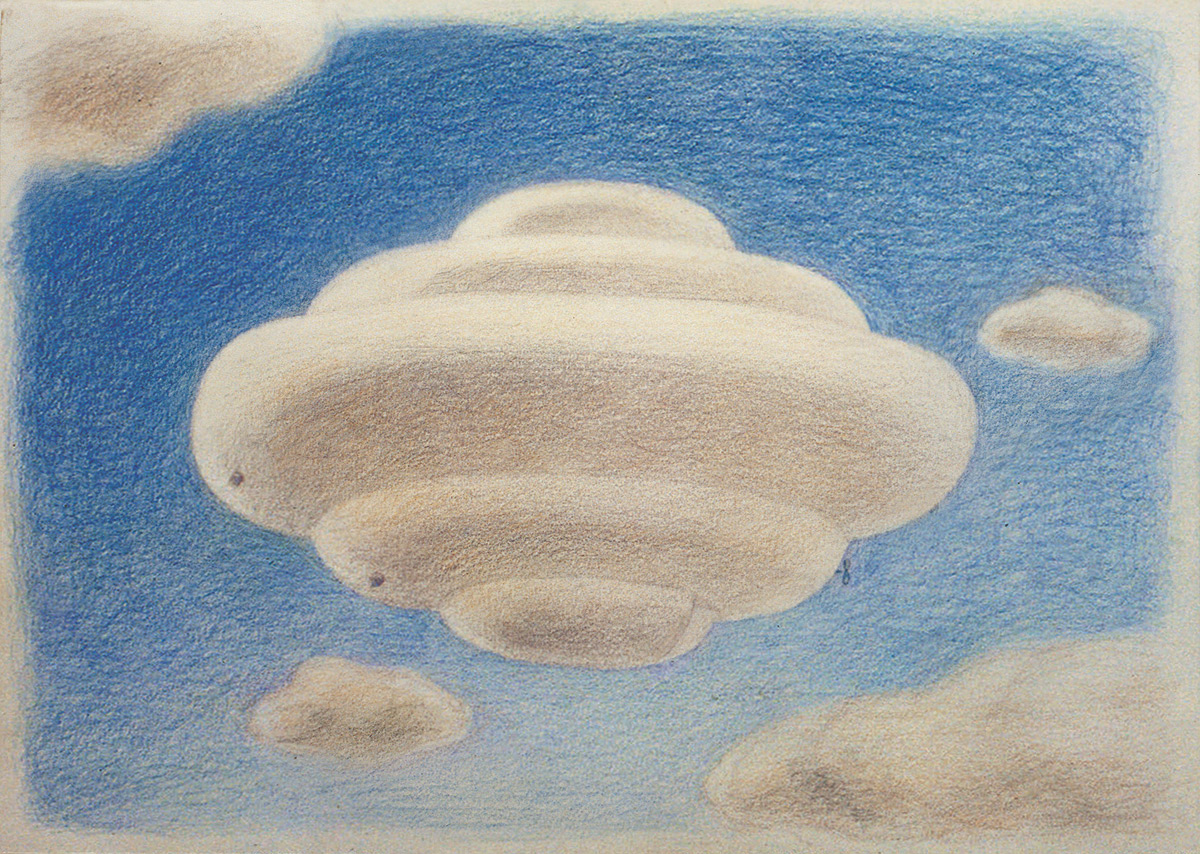
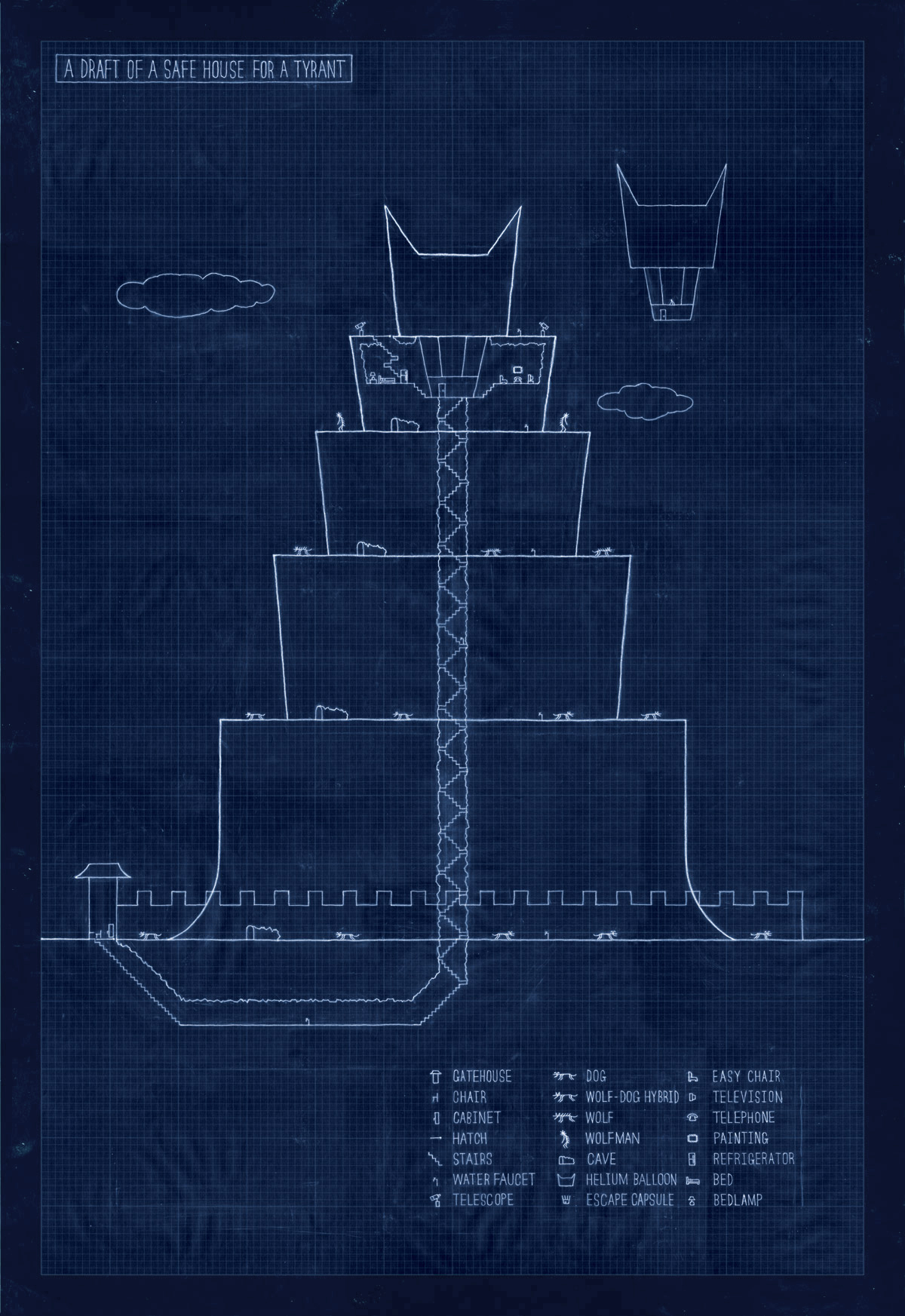
Whether they propose philosophical pondering, flights of fancy or wry social commentary, Kim Beom’s ideas manifest in the most charming ways, through gorgeous drawings, deliberately ham-fisted porcelain, prose writing, and arrangements of humble, everyday objects. Part of the generation of Korean artists who came of age during the democracy struggles of the 1980s, Kim has developed a conceptually informed, materially rich practice whose humility of scale and tone belies the sharp observations and absurdist humour of its content. Kim’s ‘Blueprints and Perspectives’ are a series of satirical drawings and plans for imaginary structures that the artist has developed since 2002. These include a school that offers lessons in defying gravity, a spy ship disguised as a cloud, and a bat-shaped safe house for tyrants, complete with escape pod.
Kim Beom/ South Korea b.1963 /Residential Watchtower Complex for Security Guards2017 / Inkjet print on cotton paper; cyanotypes on Saunders 638gsm paper; framed / Inkjet print: 37 x 52.1cm; Cyanotype: 127.3 x 81.9cm; Cyanotype: 37 x 52.2cm / Purchased 2017. Queensland Art Gallery | Gallery of Modern Art Foundation / Collection: QAGOMA
Kim Beom’s ‘Blueprints and Perspectives’ series, which was begun in 2002, depicts imaginary machines, vessels and structures. Each work typically consists of a lavishly rendered architect’s impression accompanied by a blueprint. As gleeful and humorous as these plans appear — with an engineering inventiveness appropriate to children’s fiction — they retain a parodic and sinister edge.
Kim belongs to the generation of South Korean artists whose adult life has coincided with their country’s transition to civilian democracy, and he takes a critical view of social developments. He has described his ‘Blueprints and Perspectives’ as metaphors for society, based on the absurdity, inhumanity, arbitrariness and contradiction that he has experienced in his own life. The matter-of-factness of the blueprint reflects the depersonalisation and machine-like logic of contemporary economics and social design.
Kim points out that while none of the creations detailed in his ‘Blueprints and perspectives’ series are real, ‘they are not that much more absurd and irrational than many things that we find in the real world’.
From portraits without pictures to predatory prey, the South Korean artist’s idionsyncratic work delights in upending established orders and power dynamics
It is a vanishingly rare event, but it does happen: an artist makes a work that is so effective, so potently charismatic – too charismatic, you could even say – that it takes on a life of its own. This is a fraught experience, at once a gift and a curse. The piece may win its creator new fans, but as it circulates, various odd, and sometimes ill-informed, interpretations have been known to accrue.
The South Korean artist Kim Beom, who is fifty-nine, has made such an artwork: a spellbinding 2012 video titled Yellow Scream, in which an actor, Choi Kyong-Ho, demonstrates how to make an abstract painting in 30 minutes. Staring straight at the camera, the man counsels his viewers: “You may find it hard to think about something or make decisions” when painting. His advice: “Don’t think; just choose your colours and move your brush as you feel.” And so he proceeds to do just that. As he makes careful horizontal strokes in shades of yellow, he leans towards the canvas and screams. This artist has range. He paints what he terms “some screams of unbearable confusion” and “a short scream expressing a flashing pain”. Each mark, each scream, is a bit different.
A quick internet search can yield stories about it on clickbait-y sites with headlines like ‘Try Not to Laugh as This Man Calmly Paints Yellow Lines While Screaming’ and ‘Meet the Anti-Bob Ross of Korea’. That latter characterisation seems particularly misjudged – the actor actually comes across as decidedly pro-Ross, exuding the same earnestness and equanimity as the beloved TV painting-instructor. He is sincere and patient, and he wants you to learn. The issue is just that this painter’s artistic goals (and Kim’s) are a bit more antic than Ross’s.
Kim may not be satirising Ross, but he has other targets.Yellow Screamcomes across as a sendup of both a certain type of rarefied abstraction and the outrageous claims that are made about its ability to transmit emotions, narratives and ideas. It recalls Tom Wolfe’s indictment in 1975, in his bookThe Painted Word, that art was no longer about ‘“seeing is believing,” you ninny, but “believing is seeing” forModern Art has become completely literary: the paintings and other works exist only to illustrate the text’.(The emphasis is Wolfe’s.)
That is not to say that Kim is some archconservative, lobbying for a return to theory-free visual pleasure. He is no anti-intellectual. A piquant scepticism and a zest for invention (frequently camouflaged as nonchalance) define his idiosyncratic practice. Across various mediums, in diverse tones, his artworks prod viewers to consider what they are willing to believe, and what they are willing to accept – aesthetically and politically.
A 2010 installation, Objects Being Taught They Are Nothing But Tools, enacts an indoctrination session. It places cheap household products – a table fan, a kettle, a nightlight – in tiny chairs in front of a chalkboard and a television, on which a man delivers a tedious lecture. “Some of you use electricity,” he says. “Others use batteries.” You may find yourself feeling sorry for them. Reminding myself that they were only objects, I just felt sorry generally, thinking of all the systems of control we construct and endure.
Kim delights in highlighting and upending power dynamics with light touches and deadpan humour. In a 2010 video, Spectacle, he reverses the action of nature documentaries and has a cheetah fleeing a superfast antelope. In other video installations from that year, we encounter A Ship That Was Taught There Is No Sea and A Rock That Was Taught It Was a Bird. A 2008 canvas called Denial presents a kind of challenge to its viewers, plainly stating in black letters, ‘THIS IS NEITHER A CANVAS NOR A PAINTING’ and ‘THERE IS NO SUCH THING HERE’. As the old saying goes: who are you going to believe, me or your lying eyes?
All works of art ask us to suspend our disbelief – or, at least, to believe in them. (‘Ceci n’est pas une pipe’, another trickster, René Magritte, informed his viewers.) Kim makes this moment of decision, this choice, the fulcrum of his art. He ‘emphasizes the internalized action of the viewer to believe or not believe’, as the curator Paola Morsiani has written about Kim’s (sometimes-sinister) pedagogical installations. In 1994 Kim used a pencil to draw a small circle on a piece of paper and wrote, ‘believe this circle is alive’, ‘believe this circle can think’ and a couple other bold imperatives. Are you buying it?
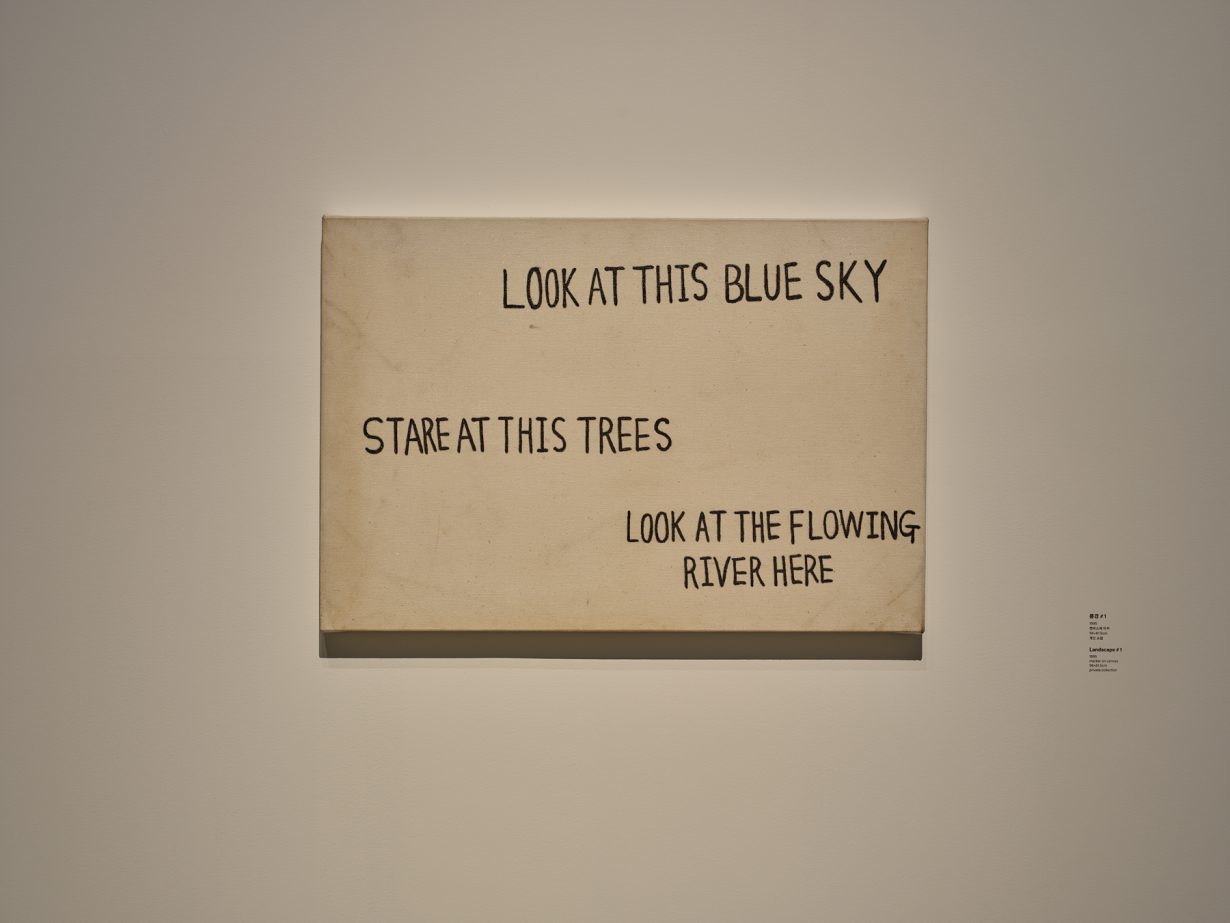
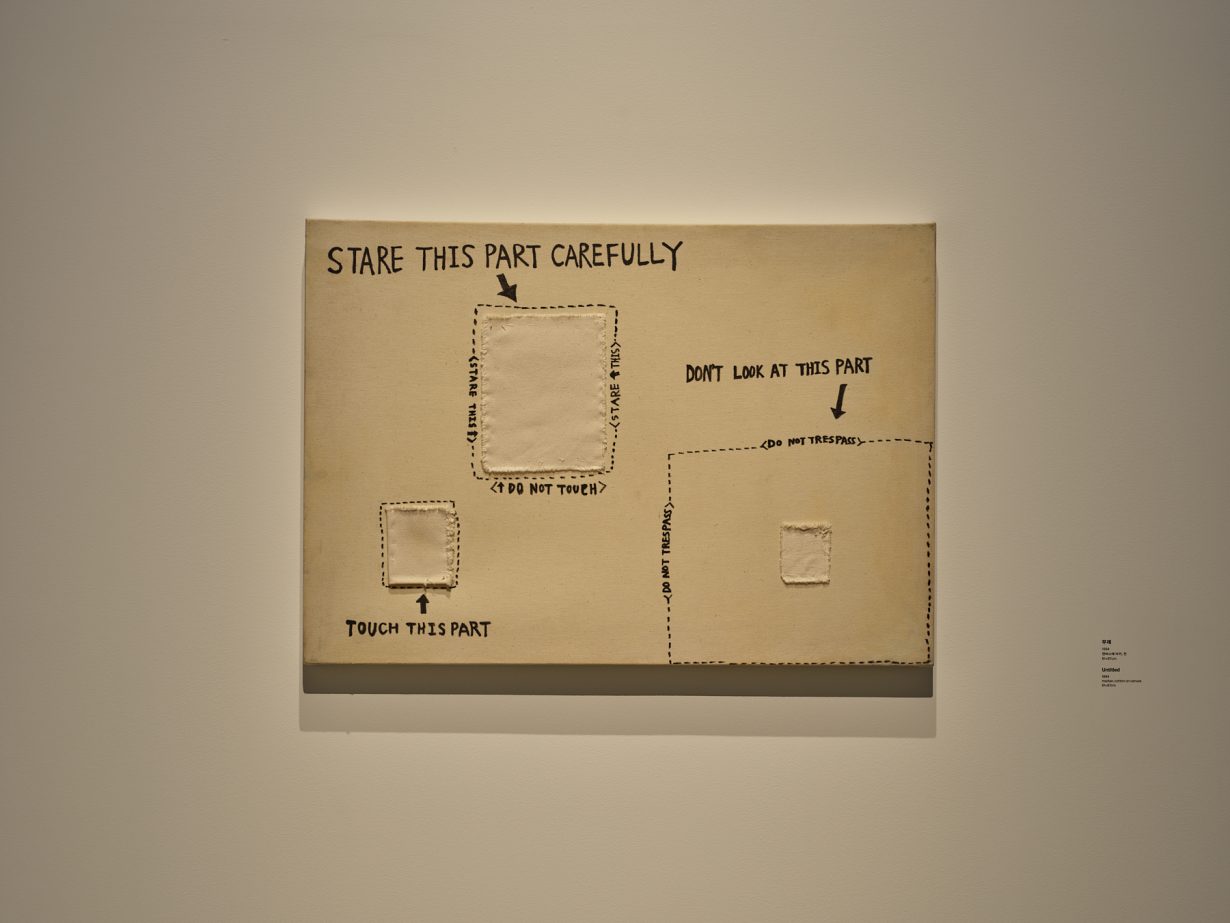
Kim started out as a painter, and in his formative works from the 1990s you can see him questioning artistic customs, toying with how a painting should behave, how it should look and how it should address its audience. He cut into a canvas, folding the flaps and attaching buttons to make shirt pockets for Self-Portrait (1994). He sewed together rectangular slices of canvas to render Brick Wall #1 (1994). And he affixed cotton swatches to a canvas and used a black marker to draw arrows and lay down some rules: ‘DON’T LOOK AT THIS PART’ (too late) or ‘TOUCH THIS PART’. An untitled 1995 piece bears a rolled-up paper and a note: ‘TAKE THIS POEM WITH YOU’. At Kim’s current retrospective at the Leeum Museum of Art in Seoul, a gallery attendant at the entrance informs visitors that touching the works is, in fact, verboten, which makes his pictures both funnier and sad – cut off, alienated.
Landscape #1, 1995, marker on canvas, 56 × 82 cm.
Untitled, 1994, marker, cotton on canvas, 61 × 87 cm. That exhibition is titledHow to become a rock, which comes from writing by Kim that, I think, hints at the abiding conflict within his art, the productive friction that fuels it. In that text, which was part of his 1997 bookThe Art of Transformation, he advises: ‘Ignore the changes of the seasons and the weather, and do not think at all’. And he says, ‘Even if it happens that a physical force such as a heavy rain will shake you and roll you down, do not be concerned about it. Just keep your original posture.’ Being a rock apparently involves sticking to your beliefs, but it also means a kind of inflexibility, a wilful hermeticism.
Is Kim a rock? In some sense. He has eschewed a signature style but charted a singular course, wielded the language of sundry art movements for his own incisive ends: the canonical text-based conceptualism of Robert Barry and Yoko Ono, the research-based installation art of so many biennials past, and more. From one vantage point, he is a kind of court jester of contemporary art, poking at its pretensions, stripping it down to its basics and turning it into something else (a painting as a shirt, an instructional video as a comedy act). In a pivotal early effort, he made a painting of chicken and sold it for $11.95, the price of a chicken dish he wanted to buy – a painting as actual currency, pure use value. At the 2012 Gwangju Biennale, he sold paper-clay sculptures of whole chickens and used the profits to buy 2,840 vouchers for underprivileged children to buy chicken. (These are only a few of his chicken-related pieces.)
Taken together, these disparate actions suggest an artist who is endlessly inquisitive about art’s efficacy. Kim has serious doubts about the art enterprise, but he is not a cynic, and he is sceptical only because he seems to want more from art than our present world provides. He is also restless. Each new series he starts leaps across the aesthetic map. One problem of writing about his art is that it has taken so many forms that it is impossible to summarise it all. (Another problem is that many of his artworks are very funny, and it is horrible to explain a joke.)
Spy Ship (Perspective), 2004, colour pencil on paper, 40 × 53 cm.
A Draft of a Safe House for a Tyrant, 2009, blueprint, 98 × 68 cm.
This is a plainspoken art, and an art that is aware of the cruelties of the world: where lies are told, where people are repressed and where a ship might be taught that there is no sea. Since 2002, Kim has been creating renderings for fantastical, occasionally menacing buildings, like A Draft of a Safe House for a Tyrant (Perspective) (2009), and in 2008 he began a series called Intimate Suffering, which offers dense mazes on canvas, each a hard-edge, Op-art abstraction as an exhausting game. One from 2014 is nearly five metres tall, and while I have tried to complete it, gliding my eyes along its passages, I always give up way before the end. Kim rarely consents to interviews, but he has said of those puzzles, ‘Life comes with its share of problems, and solving problems and finding the right way is hard, but it seems to be human instinct and nature to do so.’
And so we might ask: amid tough times, is it worth trying to ‘keep your original posture’, like a rock? Sure, that has value in a world that demands conformity. But it is at least as important to keep trying new things. Like Kim’s puzzles, with their long alleys and distressing dead ends, one message of Kim’s whole practice is that the essential thing is to keep looking for solutions, to keep going.
Kim Beom’s solo exhibition How to become a rock is on view at Leeum Museum of Art, Seoul